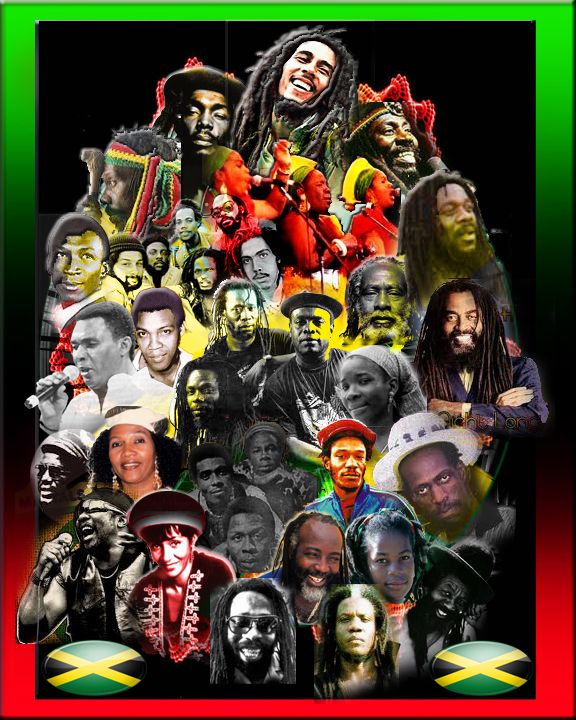
It was Bob Marley who made reggae into an international phenomenon. In the wake of his success in the 1970s came a host of other names, and it wasn’t long before reggae became an established genre of music. But reggae was simply the growth, the development, of what had been happening in Jamaican music. Beginning with ska, and then rock steady, the loudest island in the world had declared its real musical independence, and had already made an imprint on the world, albeit a small one.
If you want to take it back to the beginning, you have to blame it on jazz. One of America’s great contributions to musical culture, it swept around the world. Through radio broadcasts and records, Jamaica, then still a British colony, got the fever in the 1940s. Bands sprang up to entertain tourists, like Eric Dean’s Orchestra and future giants like trombonist Don Drummond and sax man Tommy McCook learned the licks and honed their chops on the music.
With the advent of the 1950s, American popular music began to fragment. In jazz, be-bop became the new movement. Rhythm and blues, the black style formerly called race music, started coming on strong. The era of the jazz orchestra was slowly fading as music grew harder, stronger, more youthful. That spread to Jamaica, just as it did to other parts of the globe.
Jamaica itself was beginning to change. It had been a mostly rural economy, but now people were flooding into the capital, Kingston, in search of their own piece of postwar prosperity. On the weekends Kingstonians old and new would gather for dances in the open spaces called ‘lawns’ all over the city, where sound systems (essentially loud, primitive mobile discos) would throb with the latest sounds from the States. If you didn’t have a radio – and in the poor economy, many didn’t – this was how you heard the new records.
R&B was the diet of the sound systems. Fast, raw, and with a thick beat, it played well to both young and old. Sound system owners would travel to the U.S. to buy new records, or have agents ship them over. It was a constant war to have the newest, freshest sounds. A popular disc might be played 15 or 20 times during the course of a dance.
By the mid-50s two sound systems stood head and shoulders above the crowd in Kingston – Duke Reid with the Trojan, and Clement Dodd with Sir Coxsone Downbeat. Competition between them was fierce, and would last well into the next decade, one of the major catalysts for the growth of the Jamaican music industry. The sound systems had no choice but to play American records, because the island simply had no recording facilities. Stanley Motta had made some tapes of the native mento folkloric music, but it wasn’t until 1954 that the first label, Federal, opened for business, and even then its emphasis was purely on licensed U.S. material.
The kick start to homegrown Jamaican music came with rock’n’roll. As it became the dominant form in America during the latter half of the ‘50s, the number of R&B releases dwindled to a trickle – not enough to satisfy the insatiable appetites of the sound systems. Something had to be done.
The first person to act was Edward Seaga, who would go on to become Prime Minister of Jamaica. In 1958 he found WIRL – West Indian Records Limited – and began releasing records by local artists. They were blatant copies of American music, but that barely mattered; they were new and playable on the sound systems. The same year, Chris Blackwell (a well-to-do white Jamaican, related to the Blackwells of Cross & Blackwell fame) got his own start as a record magnate, putting out a disc by the then-unknown singer Laurel Aitken, and within twelve months both Reid and Dodd, seeing the possibility of having records available exclusively on their systems, had jumped on the bandwagon with the Treasure Isle and Studio One labels, respectively. And once a pressing plant, Caribbean Records, had been established on the island (meaning the masters no longer had to be shipped to America for pressing), the Jamaican recording industry was well and truly born.